














Driving and Getting Around in Spain
Everything you need to get around Spain: driving on a foreign licence and exchanging it, the points licence, ITV inspections, insurance, low emission zones and DGT labels, speed and alcohol limits, fines and the 50% early payment, tolls, high-speed trains, buses, city transport passes, island flights and cycling rules.
Last reviewed 26 Nov 2026
Spain is easy to get around. It has one of the world's largest high-speed rail networks, an extensive motorway system (mostly toll-free), good long-distance buses and modern metros and trams in the big cities. Driving is the best way to explore rural areas and the coast, but traffic rules are strictly enforced by cameras and the Guardia Civil. This guide covers licences, road rules, low emission zones and public transport as of 26 November 2026. The main authority for drivers is the Directorate-General for Traffic (Dirección General de Tráfico, DGT, dgt.es), except in Catalonia and the Basque Country, which manage traffic through their own services.
Driving on a foreign licence
Visitors
Tourists can drive with a valid licence from their country. A licence that is not in Spanish and does not follow the international convention models should be carried with an International Driving Permit or an official translation. Carry your passport too.
Residents with a non-EU licence
According to the DGT, a non-EU licence is valid in Spain only for six months after you become a resident. After that you must either:
- Exchange it (canje) for a Spanish licence, if your country has an exchange agreement with Spain, or
- Pass the Spanish theory and practical tests to get a Spanish licence, if it does not.
Countries with exchange agreements include the United Kingdom, Andorra, Argentina, Brazil, Chile, Colombia, Japan, South Korea, Morocco, New Zealand, Peru, Switzerland, Turkey, Ukraine and others; the DGT keeps the full, current list and the conditions for each one, as some agreements only cover certain licence categories or require a test. Check yours with our driving licence checker. The exchange is done with an appointment at a provincial traffic office (Jefatura Provincial de Tráfico) and a fee.
Residents with an EU or EEA licence
Licences from EU and EEA countries remain valid in Spain while they are in date. You do not need to exchange them, but you follow Spanish rules on renewals and medical checks once you live here, and you can register your licence with the DGT.
The points licence (carné por puntos)
- Most drivers start with 12 points. Novice drivers (in their first years) and people who get their licence back after losing it start with 8 points.
- After 3 years without offences that cost points, you gain 2 points (to 14), and after another 3 years 1 more, up to a maximum of 15.
- Serious and very serious offences cost 2, 3, 4 or 6 points. Examples that cost points include speeding, using a hand-held mobile phone, not wearing a seat belt and driving over the alcohol limit.
- If you lose all your points, your licence is suspended and you must complete a course and pass a test to get it back.
Check your points balance with a digital certificate or Cl@ve on the DGT website or the miDGT app.
ITV (vehicle inspection)
The ITV (Inspección Técnica de Vehículos) is Spain's roadworthiness test, carried out at authorised stations, usually with an appointment. For private cars:
- No inspection in the first 4 years
- Every 2 years from 4 to 10 years old
- Every year after 10 years
A car with a failed or expired ITV cannot legally be driven except to the inspection station. The sticker on your windscreen shows when the next test is due.
Insurance
Third-party liability insurance (seguro obligatorio) is compulsory for every vehicle, even when parked. Many drivers add fire, theft and glass cover, or fully comprehensive (todo riesgo). Ask your previous insurer for a no-claims letter, which Spanish insurers may accept for a discount. Carry proof of insurance and the vehicle documents in the car.
Low emission zones (ZBE) and DGT labels
Under the 2021 climate change law, towns with more than 50,000 inhabitants, island territories and some smaller towns with poor air must set up low emission zones (zonas de bajas emisiones, ZBE). Madrid, Barcelona and many other cities already restrict the most polluting vehicles, and each city decides its own rules, timetables and fines.
Access depends on the DGT environmental label (distintivo ambiental):
| Label | Typical vehicles |
|---|---|
| 0 (blue) | Battery electric, long-range plug-in hybrids, fuel cell |
| ECO | Other plug-in hybrids, hybrids, gas-powered (LPG, CNG) |
| C (green) | Petrol cars generally from 2006, diesel cars generally from about 2014 to 2015 (Euro 6) |
| B (yellow) | Petrol cars generally from 2001, diesel cars generally from 2006 |
| No label | Older vehicles, often banned from ZBEs |
You can check your car's label by registration number on the DGT website, and buy the sticker at post offices (Correos) and some garages. Foreign-registered cars are not automatically classified: many cities require you to register a foreign vehicle in advance to enter their ZBE. Check the city's website before driving in.
Speed limits
| Road | Cars and motorcycles |
|---|---|
| Motorways (autopista and autovía) | 120 km/h |
| Conventional roads | 90 km/h |
| Urban roads with one lane in each direction | 30 km/h |
| Urban roads with two or more lanes in each direction | 50 km/h |
| Single-surface urban streets (road and pavement at the same level) | 20 km/h |
Lower limits apply to vans, vehicles with trailers and where signs say so. Speed cameras, including section cameras, are common.
Alcohol limits
- General drivers: 0.5 g/l in blood or 0.25 mg/l in breath.
- Novice drivers (first two years) and professional drivers: 0.3 g/l in blood or 0.15 mg/l in breath.
Random breath tests are common, and drug tests are also carried out. Above certain levels, drink driving is a criminal offence. The safest rule is not to drink at all if you are driving.
Other key rules
- Seat belts are compulsory for everyone, and children under 135 cm generally need an approved child seat.
- Hand-held mobile phones are banned while driving, even when stopped in traffic.
- Carry your licence, the vehicle registration document (permiso de circulación), the ITV card and insurance.
- Breakdowns: instead of warning triangles, the rules now require a connected V-16 emergency light on the roof of the car. Check the current DGT rules for your vehicle.
- Give way to traffic already on roundabouts and use the right-hand lane unless you are leaving soon.
Fines and the 50% early payment
Traffic fines (multas) from the DGT and most city councils offer a 50% discount if you pay within 20 calendar days of being notified, but you then lose the right to appeal. Fines can be paid online, by phone, at post offices or by app. Foreign-registered cars are not exempt: fines can be sent abroad through EU cross-border rules, and police can require visitors to pay on the spot. Look up common amounts with our traffic fines tool.
Register with the DGT's electronic road address (Dirección Electrónica Vial, DEV) to receive fines digitally, so you never miss a deadline.
Tolls
Most Spanish motorways (autovías) are free. Several former toll motorways became free between 2018 and 2021, including most of the AP-7 along the Mediterranean coast. Tolls (peajes) remain on some routes, such as the AP-6 north-west of Madrid, the AP-9 in Galicia, several motorways around Madrid and some roads in the Basque Country. Signs show toll roads in advance, with free alternatives usually signposted. Electronic tags (telepeaje) speed up payment.
Trains
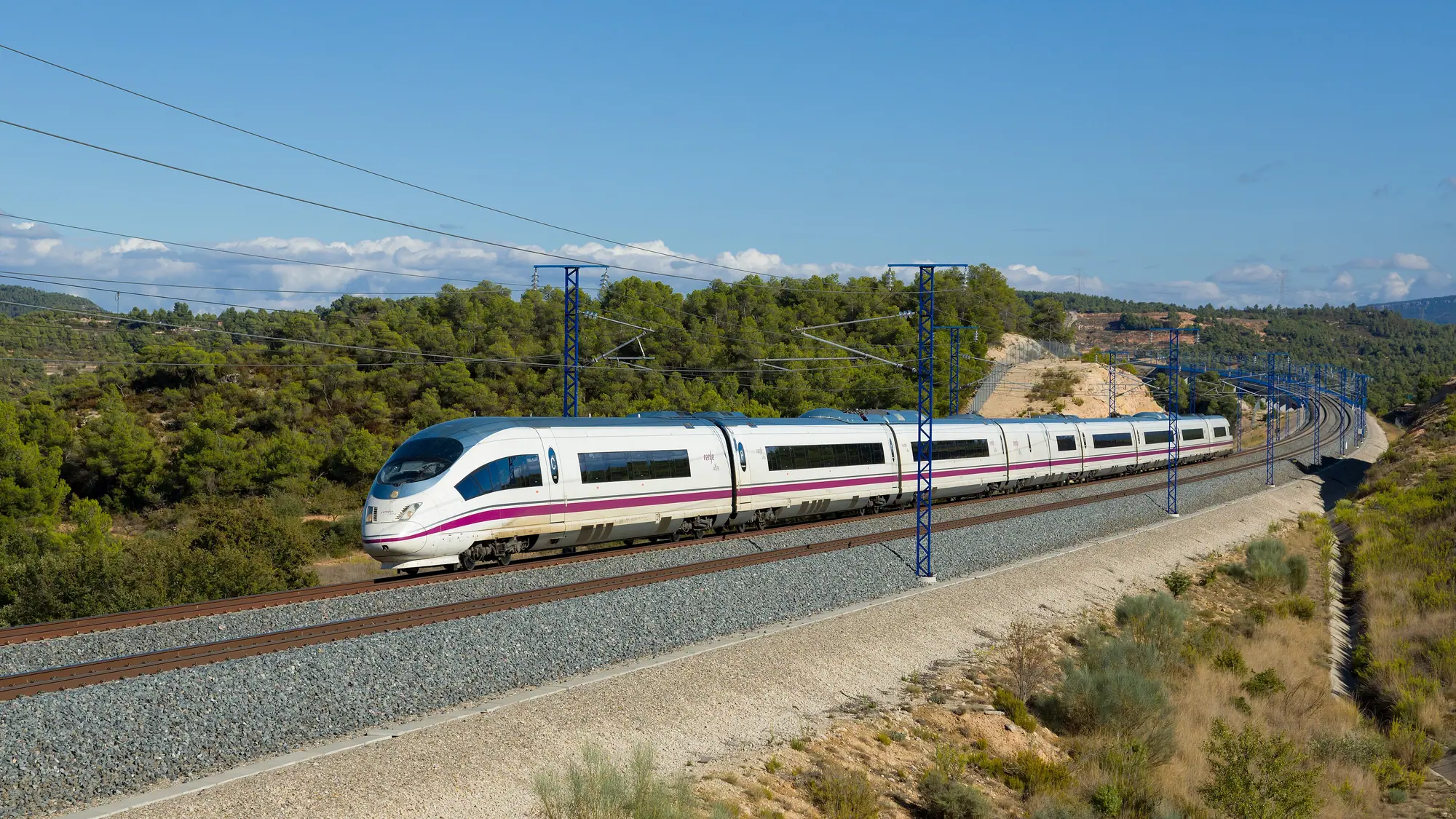
Renfe (renfe.com) is the state rail operator. Since rail liberalisation, high-speed lines also have private competitors.
- AVE: Renfe's main high-speed service, linking Madrid with Barcelona, Seville, Málaga, Valencia, Alicante, Galicia, Asturias and more.
- Avlo: Renfe's low-cost high-speed brand.
- Ouigo and Iryo: private high-speed operators on major routes such as Madrid to Barcelona, Valencia, Alicante, Seville and Málaga.
- Alvia and Intercity: long-distance trains on mixed routes.
- Media Distancia: regional trains between cities.
- Cercanías (Rodalies in Catalonia): commuter trains around major cities.
Prices for high-speed tickets vary with demand, so booking early usually costs less. Renfe and the government have offered discounted or free multi-journey passes on commuter and regional trains in recent years; check what applies now on renfe.com.
Long-distance buses
Coaches connect almost every town in Spain and are often the cheapest option. Alsa is the largest operator, alongside many regional companies. Major cities have central bus stations (estación de autobuses), and tickets are sold online and at the station.
City transport
Madrid, Barcelona, Valencia, Bilbao, Seville, Málaga, Palma and other cities have metros, trams or extensive bus networks. Monthly passes (abonos) are good value for regular travellers, and there are usually reduced fares for young people, older people and large families. Some systems also accept contactless bank cards for single journeys.
- Read our Madrid metro guide and compare fares with the metro fare tool.
- See the city pages for Madrid, Barcelona, Valencia, Bilbao and Seville.
Flights between the islands and the mainland
The Balearic Islands and the Canary Islands are linked to the mainland and between islands by frequent flights and ferries. Residents of the islands, Ceuta and Melilla get a large resident discount (descuento de residente) on domestic flights and ferries to and from the mainland and between islands, when they show their resident certificate. Airports are run by Aena (aena.es).
Cycling and e-scooters
- Bicycles must have lights and reflectors at night, and riders must not use headphones or a hand-held phone.
- Helmets are compulsory for all cyclists on roads outside towns, and for under-16s everywhere.
- Alcohol limits also apply to cyclists.
- Riding on pavements is generally not allowed unless signs permit it, and city bylaws set further local rules.
- E-scooters (vehículos de movilidad personal) cannot use pavements or motorways and are limited to 25 km/h. New rules on compulsory insurance for e-scooters are being introduced, so check dgt.es before you buy one.
- Most cities have public bike-share schemes, such as BiciMAD in Madrid and Bicing in Barcelona.
For your first weeks in Spain, see our moving to Spain checklist.
Frequently asked questions
Can I drive in Spain with my UK licence?
Visitors can drive with a valid UK licence. If you become resident, you can drive on it for six months, then you must exchange it for a Spanish licence. The UK has an exchange agreement with Spain, so in most cases no test is needed.
Do I need an environmental sticker to drive into Madrid or Barcelona?
Many cities restrict access to their low emission zones by DGT label, and cars without a label are often banned. Foreign-registered cars may need to be registered with the city in advance. Check the city council's website before you travel.
How much do I save by paying a traffic fine early?
Most DGT and municipal fines are reduced by 50% if you pay within 20 calendar days of notification. In exchange you give up the right to appeal.
What is the speed limit on Spanish motorways?
120 km/h for cars and motorcycles on autopistas and autovías, unless signs show a lower limit. Conventional roads are 90 km/h, and most urban streets are 30 or 50 km/h.
Is the train better than flying between Madrid and Barcelona?
For many travellers, yes. High-speed trains from Renfe, Ouigo and Iryo run between the two city centres, avoiding airport transfers and security queues. Compare prices and journey times on the operators' websites, as fares change with demand.
More questions
Can I drive in Spain on my foreign licence?
EU and EEA licences are valid in Spain for as long as they are in date. Visitors with other licences can drive with their national licence, plus an International Driving Permit where the DGT requires one. Once you become resident, a non-EU licence is valid for only six months: after that you must exchange it at the DGT, if Spain has an exchange agreement with the issuing country (as it does with the UK), or pass the Spanish driving test. Spain drives on the right, the drink-drive limit is 0.5 g/l of blood (0.3 g/l for new and professional drivers), and the emergency number is 112.
Daleel ES is a guide, not legal, financial or immigration advice. Rules change; confirm with the authority named before you act. Spotted an error? Tell us.